
I am an (INTJ) Ph.D candidate at Department of Earth System Science, Tsinghua University. My major is atmospheric science, and I currently conduct research at the intersection of atmospheric science and artificial intelligence. I started working with Prof. Haohuan Fu in Fall 2021, prior to that, I got my Bachelor’s degree at UM-SJTU Joint Institute, Shanghai Jiao Tong University, majoring in Mechanical Engineering.
If you are interested in [八字 Chinese astrology /求签 fortune sticks /幸运数字 lucky numbers], feel free to check out 玄占实验室/XUANZHAN LAB, which is a website built entirely by Codex, since I have no front-end development experience.
📝 Publications
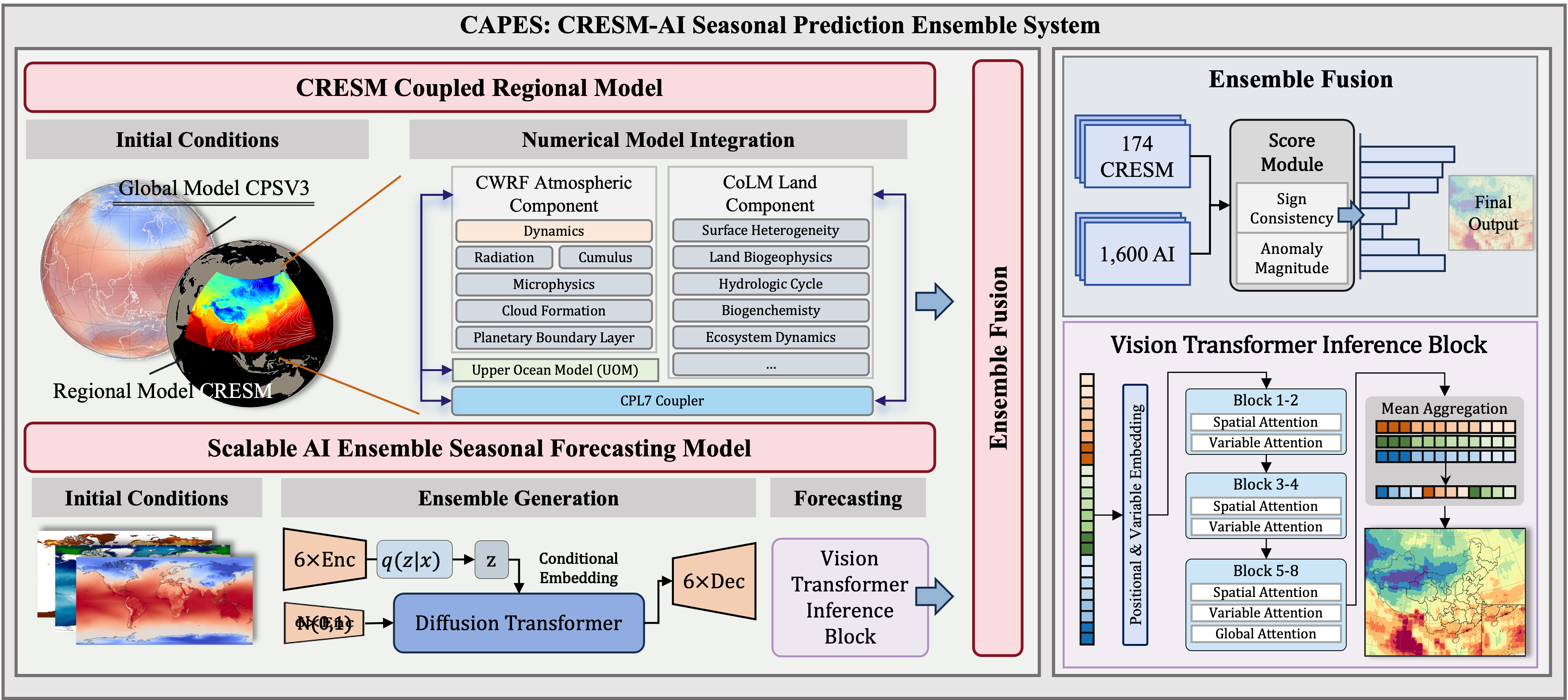
Mengxuan Chen, Yunpu Xu, Qiuyan Sun, Han Zhang, Jiayi Lai, Zheng Zhou, Juepeng Zheng, Hongsong Meng, Nan Wei, Jinxiao Zhang, Xiongchuan Tan, Haodong Bian, Yinan Cai, Ge Yang, Fang Wang, Yunyun Liu, Conghui He, Runmin Dong, Lanning Wang, Yutong Lu, Yongjiu Dai, Haohuan Fu*.
- Seasonal forecasting of summer rainfall in East Asia remains a grand challenge, as predictability at 3 to 6 month lead times is constrained by the spring predictability barrier, weak large-scale signals, and localized nonlinear convective extremes. We address this challenge with CAPES, which integrates a kilometer-resolution coupled regional model with atmosphere, land, and ocean components and a data-driven AI seasonal forecasting system. At 15 km resolution, the fused workflow combines 174 numerical members from varying start times, physics schemes, and parameter perturbations with 1,600 AI members generated from initial and physical perturbations. Using the full LineShine system, CAPES completes ten annual 1,774-member hindcasts for 2016 to 2025 within 14.6 hours, improving the mean prediction score from ECMWF’s 71.8 to 75.9 and delivering a major gain in operational forecasting capability. The 1-km configuration further enables fine-scale typhoon simulation and establishes the feasibility of kilometer-scale fused ensemble forecasting on a one-week timescale.
- The development of CRESM was primarily carried out by Han Zhang, and the HPC optimization and deployment of CRESM were primarily carried out by Yunpu Xu.
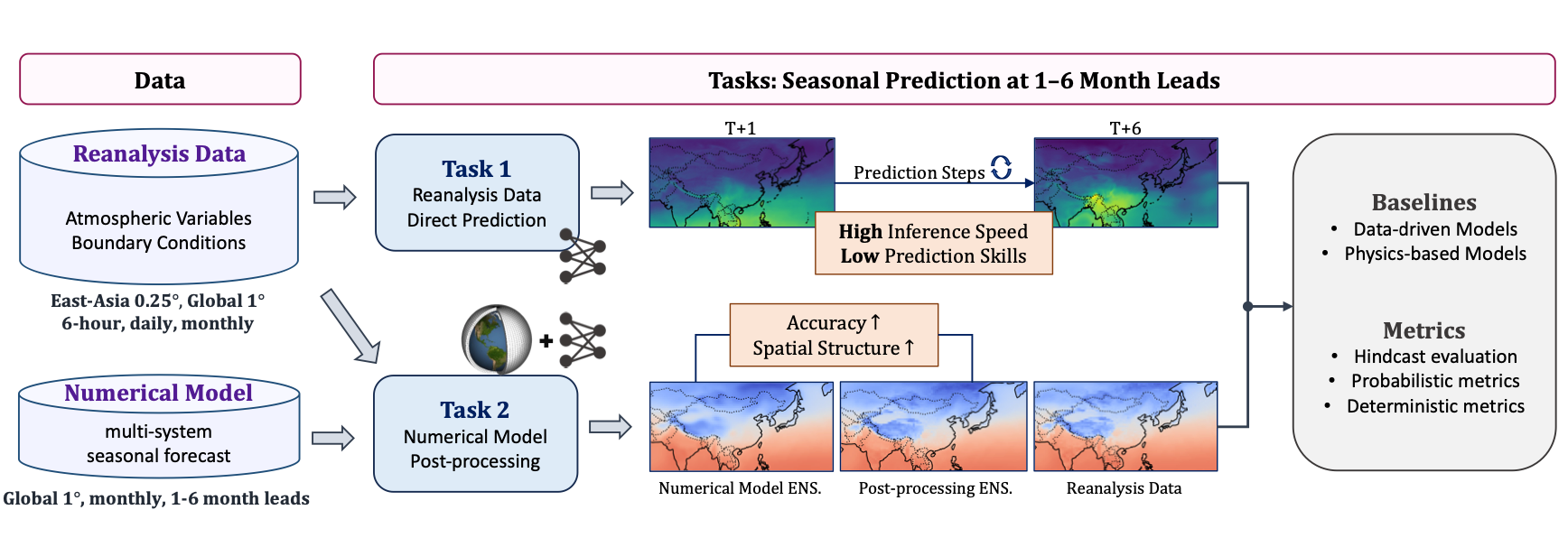
Mengxuan Chen, Guowen Li, Ziheng Zou, Fang Wang, Jinxiao Zhang, Runmin Dong, Juepeng Zheng, Haohuan Fu* (2025)
- SeasonBench-EA is a multi-resolution, multi-source benchmark dataset for seasonal prediction in East Asia. It integrates ERA5 reanalysis data, covering key atmospheric variables and boundary conditions, together with ensemble seasonal forecasts from leading operational centers. SeasonBench-EA enables two core tasks: (1) machine learning–based prediction using reanalysis inputs, and (2) post-processing of ensemble forecasts. Beyond standard deterministic and probabilistic metrics, it also includes a hindcast evaluation framework to assess long-term predictive skill and robustness.
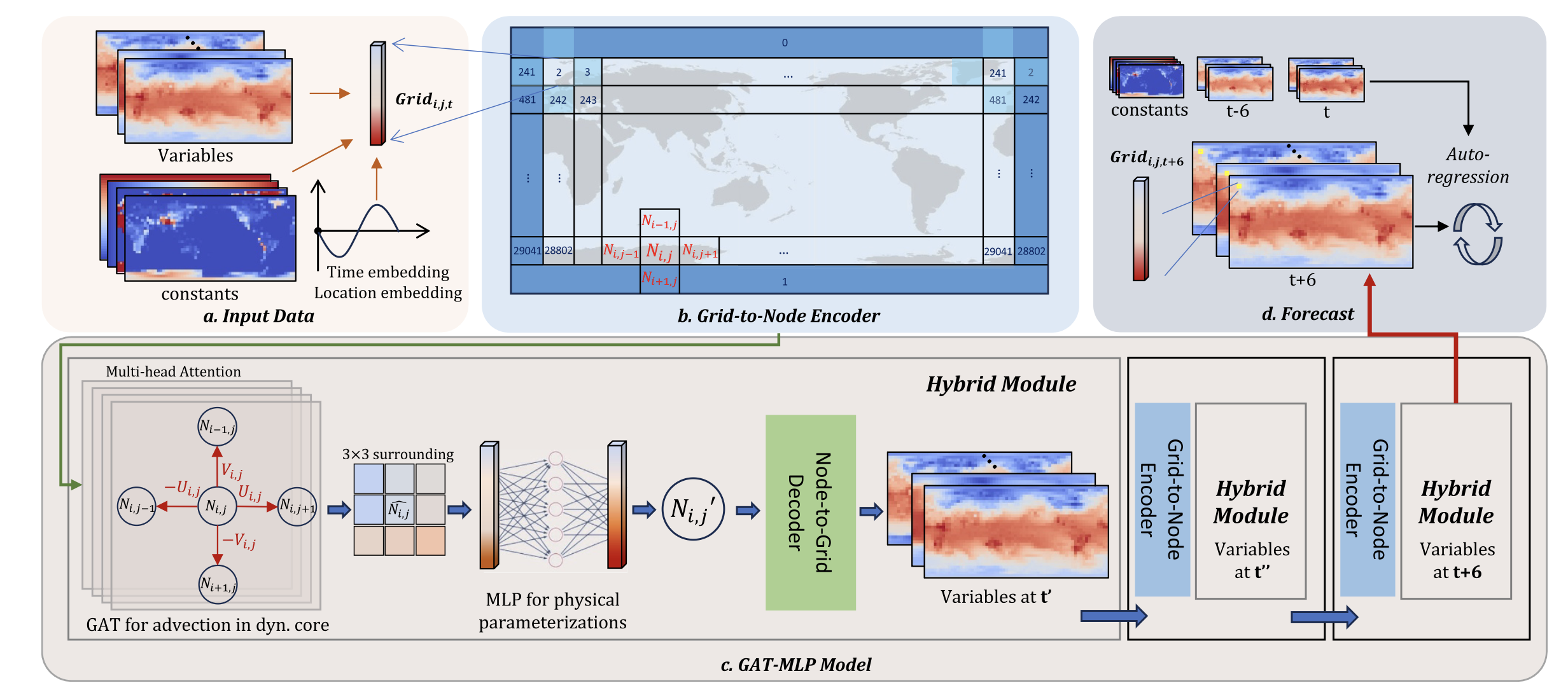
Mengxuan Chen, Jinxiao Zhang, Runmin Dong, Yidan Xu, Haoyuan Liang, Juepeng Zheng, Lanning Wang, Haohuan Fu* (2025)
- A lightweight weather forecast model with graph network and multi-layer perceptron is designed to depict dynamics and physics separately. The design of the graph follows the Arakawa C-grid, with the wind speeds embedded as edge features to simulate the large-scale dynamics. Correlations between graph parameters and atmospheric processes highlight model’s interpretability, paving way for more reliable predictions.
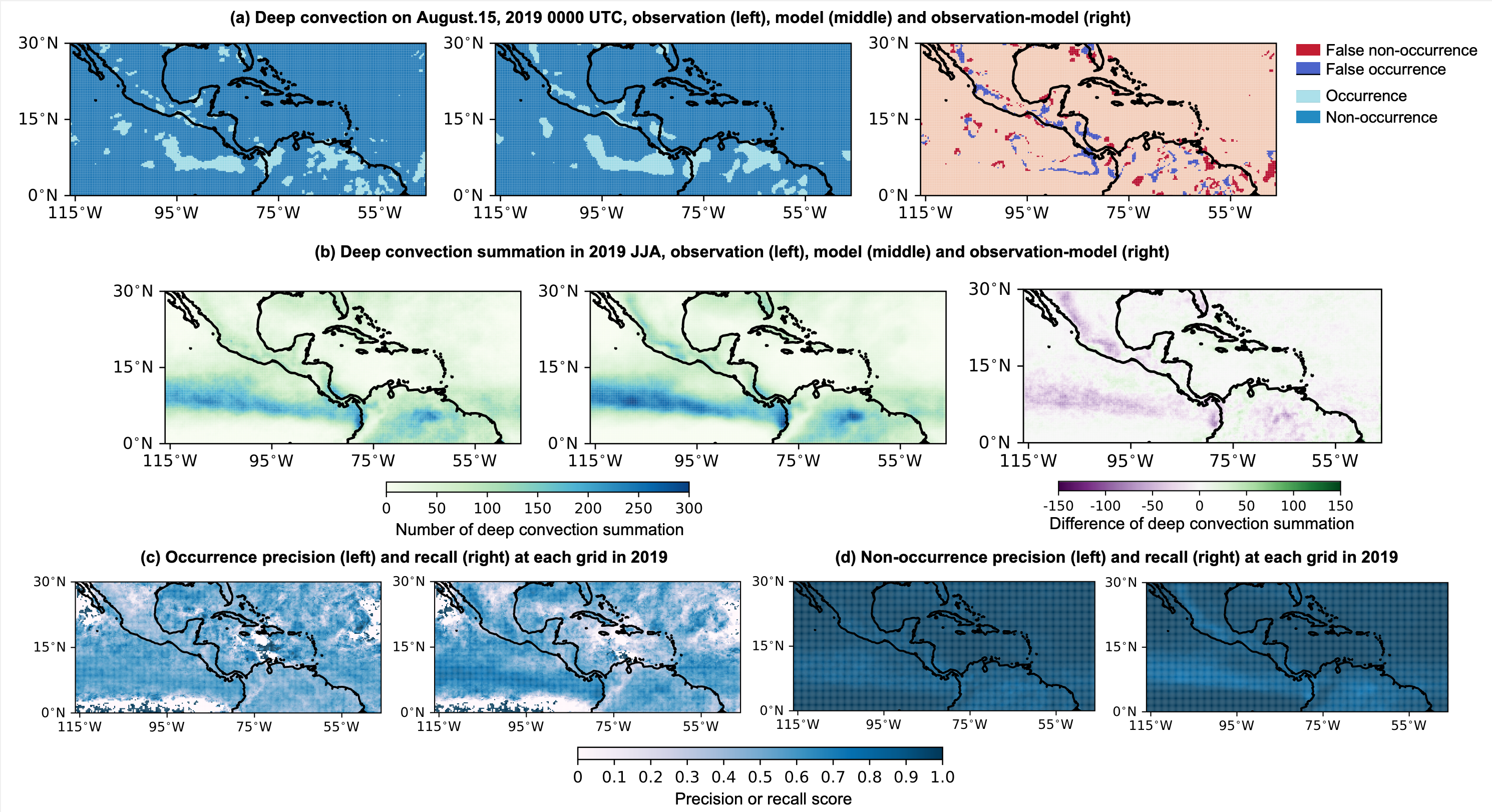
ResU‐Deep: Improving the Trigger Function of Deep Convection in Tropical Regions With Deep Learning
Mengxuan Chen, Haohuan Fu*, Tao Zhang, Lanning Wang* (2023)
- A location-aware and deep-learning-based deep convection trigger function is proposed to improve the diurnal cycle simulation in tropics. Results show that terrain information, temporal dependence of convection, and water vapor content are essential for predicting convection. Also, including information from neighboring atmospheric columns can improve the performance of the deep convection trigger function.
- Mengxuan Chen, Ziqi Yuan, Jinxiao Zhang, Runmin Dong, Haohuan Fu*. Decomposing weather forecasting into advection and convection with neural networks. arXiv preprint arXiv:2405.06590. 2024. (This work is a simplied verson of An Interpretable Weather Forecasting Model With Separately-Learned Dynamics and Physics Neural Networks)
🎖 Honors and Awards
- 2025 Tsinghua comprehensive scholarship
- 2024 Tsinghua comprehensive scholarship
- 2021 Outstanding graduate of Shanghai Jiao Tong University
- 2021 Undergraduate progress scholarship
- 2020 Undergraduate progress scholarship
- 2019 Undergraduate progress scholarship
📖 Educations
- 2021.09 - Now Ph.D Candidate in Department of Earth System Science, Tsinghua University, Beijing, China
- 2017.09 - 2021.08 B. Eng in Shanghai Jiao Tong University, Shanghai, China
- 2019.01 - 2019.02 Winter Exchange Program in Istituto Tecnologico de Buenos Aires, Buenos Aires, Argentina
👩🏻💻 Experience
- 2024.08 - Now Research Intern @ National Supercomputing Center (Shenzhen)
- Weather predictablity and interpretability, flood season predictions
- 2021.03 - 2021.05 Research Intern @ Pilot National Laboratory for Marine Science and Technology
- Optimization of NEMO ocean model on the Sunway Supercomputer
- 2020.02 - 2021.02 Research Intern @ National Supercomputing Center (Wuxi)
- Identifying deep convection with machine learning